National and cantonal referendums in comparison

«The World of Referendums: 2024 Edition» examines Swiss referendums at national and cantonal level over time. The report is based on the Referendum Database (RDB) of the Centre for Democracy Studies Aarau (CDA), which records referendums worldwide and makes them comparable.

The cantons are growing weary of voting

Figure 1: The number of cantonal referendums is declining. It seems that the cantons are becoming weary of voting. However, the reasons for this development are still unclear.

  • Mandatory referendums: Since the 1970s, the number of mandatory referendums in the cantons has been steadily declining. Mandatory referendums account for a large proportion of referendums at cantonal level (around 60% since 1970). As a result, the total number of cantonal referendums has also fallen.
  • Optional referendums: The number of optional referendums has remained relatively constant since the 1970s, rising slightly since the 2000s. However, for several years now, there has been a downward trend towards the level seen in 1970.
  • Counterproposals: Counterproposals to cantonal popular initiatives remained constant for a long time until they increased sharply in the 2010s, along with the number of popular initiatives. Today, the number of counterproposals is approaching the level of 1970 again.
  • Popular initiatives: Compared to 1970, the number of cantonal popular initiatives was initially significantly higher in the 1980s and 1990s. After a brief decline in the 2000s, the number of cantonal referendums peaked in the 2010s. Since then, the number of popular initiatives has returned to a level similar to that seen in the 1980s and 1990s.

Fig. 1: Development of cantonal referendums over time, 1970–2024 (1970 = 100%), smoothed. (Source: RDB)

The cantons practise direct democracy in different ways

Same instruments, different applications: Although the cantons draw on the same toolbox of direct democratic instruments, there are significant differences between them in practice. Depending on where they live, Swiss citizens experience very different forms of direct democracy. This is reflected both in the number of votes per canton and in the type of votes.

Number of referendums

Figure 2: Zurich leads the way with around 600 votes since 1970, followed by national votes, Basel-Landschaft and Solothurn. With just under 300 votes, the canton of Aargau ranks in the upper midfield. At the bottom of the scale is Jura, the youngest Swiss canton, with around 80 votes, followed by Fribourg and Vaud with around 120 votes each. The former Landsgemeinde cantons of Nidwalden, Obwalden and Appenzell Ausserrhoden have held the fewest votes. The two Landsgemeinde cantons of Appenzell Innerrhoden and Glarus are not included in the chart.

Fig. 2: Number of national and cantonal referendums (excluding Landsgemeinde votes), 1970–2024. (Source: RDB)

Type of referendum

At the same time, the cantons differ greatly in terms of the types of voting used:

  • At the national level, around two-thirds of all votes are triggered by signature collections. One-third of these are popular initiatives and optional referendums. The remaining third are mandatory referendums or counter-proposals.
  • At the cantonal level, only around one third of referendums are triggered by signature collections. The remaining two thirds of cantonal referendums are 1 Landsgemeinde votes are only partially recorded in the RDB. This is why the cantons of Appenzell Innerrhoden and Glarus are completely missing, as they primarily use Landsgemeinden for direct democratic decision-making. Referendums have been recorded for Nidwalden since 1997, for Appenzell Ausserrhoden since 1998 and for Obwalden since 1999. mandatory referendums, counter-proposals and executive/legislative referendums, which do not require a signature collection.
  • Figure 3: There are significant differences between the cantons in terms of the type of vote. These can be illustrated by the proportion of popular initiatives in the total number of referendums in a canton. The cantons of Vaud (40%) and Nidwalden (34%) have the highest proportion of popular initiatives. With 17%, the canton of Aargau is in the middle of the pack. In contrast, Valais and Graubünden have the lowest proportion, with 5% each.

Fig. 3: Proportion of referendum types in selected cantons, 1970/1997–2024. (Source: RDB)

Explanatory approaches

  • Changes over time: The decline in mandatory referendums at the cantonal level could be attributed to changes in cantonal constitutions. However, this would need to be investigated in greater depth, as would the changes in the number of other types of votes at the cantonal level.
  • Differences between the federal government and the cantons: In general, there are fewer votes in most cantons than at the federal level. The authors believe this is because most cantons have stricter requirements than the federal government regarding the ratio of signatures to the number of eligible voters. This makes it more difficult to launch popular initiatives and optional referendums. The population also tends to be less interested in cantonal proposals, which in turn makes it more difficult to collect signatures.
  • Differences between cantons: The cantons use direct democratic instruments in different ways. The authors think this is because of how each canton’s constitution is set up. For example, direct democratic tools are more diverse in German-speaking Switzerland than in French-speaking Switzerland or Ticino. Also, the number of signatures needed to get something on the ballot tends to be lower in German-speaking Switzerland than in French-speaking Switzerland or Ticino.
  • Direct democracy toolbox: As a constitutional requirement of the federal government, all cantons must provide for mandatory constitutional referendums and popular initiatives on partial or total revisions of their constitutions. Beyond that, the cantons are free to use the direct democracy toolbox as they see fit:
    • All cantons have mandatory and/or optional financial referendums, which do not exist at federal level. Financial referendums require expenditure above a certain amount and/or duration to be approved by the people.
    • Around half of the cantons have a mandatory legislative referendum in addition to the mandatory constitutional referendum. This means that, in addition to constitutional amendments, certain legislative amendments are also subject to a mandatory vote.
    • In some cantons, generally binding parliamentary decisions and parliamentary ordinances are also subject to optional referendums.
    • In some cantons, the parliament can also launch a referendum.

Further resources

Report

Ezzaini, Juri, Jonas Wüthrich, Salim Brüggemann, Kymani Koelewijn, Gianluca Sorrentino, Robin Gut, and Uwe Serdült. ‘The World of Referendums: 2024 Edition.’ Study reports from the Centre for Democracy Aarau, 30. Aarau: Centre for Democracy Studies Aarau (ZDA), 2024. The report and data set are available at https://report.rdb.vote/ and https://c2d.ch/ respectively.

The Referendum Database RDB

The report «The World of Referendums: 2024 Edition» is based on data from the Referendum Database (RDB). The database was founded in 1994 at the University of Geneva. It contains key figures on all national referendums worldwide, as well as a growing number of subnational referendums. The additional institutional variables for each country and interactive graphics make the RDB a valuable tool for researchers and interested citizens. An interdisciplinary team of lawyers and political scientists at the Centre for Democracy Studies Aarau manages the RDB and continuously develops it further. Additional reports are published periodically.

About the Centre for Democracy Studies Aarau (CDA)

The Centre for Democracy Studies Aarau is a scientific research centre supported by the University of Zurich, the University of Applied Sciences and Arts Northwestern Switzerland, the Canton of Aargau and the City of Aarau. It conducts basic research and addresses current issues relating to democracy – regionally, nationally and globally: www.zdaarau.ch

Contact

Robin Gut
Project manager «The World of Referendums: 2024 Edition»
076 470 87 05
robin.gut@zda.uzh.ch

Citizens’ Assembly discusses ways to tackle rising healthcare costs

  • The 2025 Citizens’ Assembly, consisting of 100 randomly selected residents of Switzerland,
    is meeting for the first time this weekend at the University of Zurich.
  • During the kick-off weekend, participants will gain an in-depth understanding of the topic of «rising healthcare costs» and determine a focus for further discussions.
  • The research project coordinated by the Centre for Democracy Studies Aarau (ZDA) at the
    Universities of Zurich and Geneva is investigating whether and how citizens’ assemblies
    enrich democratic debates.

Rising healthcare costs are among the most pressing challenges facing Switzerland.
With premiums skyrocketing, hospitals closing and healthcare staff overworked, healthcare policy is in crisis – solutions are needed. This weekend, the Citizens’ Assembly is meeting at the University of Zurich. At this kick-off meeting, 100 randomly selected participants from across Switzerland with different backgrounds and experiences will come together to discuss the issue.
from all over Switzerland with different backgrounds and experiences will engage in conversation with one another.


The Citizens’ Assembly is a new way for citizens to come together to discuss important social issues and negotiate solutions. The focus is on ordinary Swiss residents: people of all ages, from
a wide range of professions and regions of the country. Over the course of several weekend events and digital meetings, they will take an in-depth look at the current problem of rising healthcare costs. This randomly selected group reflects the diversity of perspectives and experiences within society and thus brings its own concerns and needs to the discussion.


Basic insurance, hospitals or coordination of care?


During the opening weekend, participants will receive a comprehensive overview of the
functioning and objectives of the Citizens’ Assembly. In addition to getting to know each other and
familiarising themselves with the topic of ‘rising healthcare costs’, participants will define a
focus for further discussions. The aim is to narrow down the topic and determining what is particularly relevant to the People’s Council – for example, basic insurance, hospitals, volume expansion, coordination of care, or health promotion and prevention.


New impetus in health policy


The research project investigates whether citizens‘ assemblies are suitable for conducting important social debates. Particularly in the field of health policy, where political decision-making often stagnates, citizens’ assemblies could provide new impetus. The topics for the citizens’ assembly were selected in a transparent and broadly supported process, which identified healthcare costs as a particularly urgent issue.

Prof. Dr. Daniel Kübler, co-initiator at the University of Zurich, says: «With the People’s Council,
we are creating a space where the population can directly express their views on socially important issues. In health policy in particular, we need solutions that take into account the interests and concerns of citizens.»


Citizens’ Assembly drafts final report with reform proposals


Participant and mother of two Anaïs Zingg (30) from Zuzwil in the canton of St. Gallen is excited:
«I’m looking forward to discussing rising healthcare costs with people from all over Switzerland.
It’s an issue that affects us all. Hopefully, we can make a difference as a People’s Council.»

The Citizens’ Assembly will present its findings in spring 2025. A final report is intended to form the basis for an objective, public debate and provide policymakers with a differentiated picture of opinions. In it, the Citizens’ Assembly will prepare arguments for various reform proposals and take a position on them.

This form of participation creates new spaces for social debates, strengthening the quality of public opinion formation and debate culture. This could be significant not only in health policy, but also in other areas of society.

Further information: www.pnyx25.uzh.ch

Photos of the opening weekend: https://www.flickr.com/gp/200893765@N03/77z6315bw6
(are continuously updated on the weekend)

Contact:

POLIS No. 14

POLIS No. 14 «The machine is political. AI, democracy and education»

The new issue of the magazine for political education, POLIS, has been published: «The machine is political. AI, democracy and education»

The rapid development of artificial intelligence has recently caused a stir and raises important questions that challenge fundamental democratic values: What are the consequences of new technological innovations for current democratic systems? And how can a democratic society, which is interested in promoting democratic principles rather than dismantling them, deal with them?

Particular attention will be paid to the role of schools in dealing with these developments. How are AI applications used in today’s schools? What facets of this development does civic education need to address? And to what extent is this relevant from a democratic perspective? Our contributions are intended to stimulate reflection and discussion.

Download (PDF) (German)
Order POLIS No. 14

Vote lost – is the higher budget of the opposing side the reason?

Those who spend a lot of money on a referendum campaign are noticed more. However, if we take a closer look at the subjectively perceived intensity of a campaign for yes or no voters, a distortion becomes apparent: the campaign budget of the opposing side is overestimated. Results from a research project conducted by the Centre for Democracy Studies Aarau in collaboration with Année Politique Suisse show how this comes about.

Before referendums, posters and advertisements attempt to convince Swiss citizens to vote yes or no on the proposals. But how do citizens perceive the strength and thus the effectiveness of a referendum campaign on a particular issue? And does this subjective assessment correspond to the objectively measurable advertising expenditure? This is being investigated in an evaluation as part of the research project «Direct Democracy Switzerland in the 21st Century (DDS21)» (see box).

Budget creates effective campaigns

When citizens are asked how effective referendum campaigns are, their assessment corresponds quite closely with the measurable criteria of «advertising expenditure» and «advertisement volume». The authors of the evaluation note: «The assessment of the intensity of the campaigns shortly before the referendums in March and June corresponds to the measurable actual intensity. In both cases, respondents rate the advertising campaigns with the largest budgets and the highest volume of advertisements (13th AHV pension and Electricity Act) as the most intense.»

If you think your opponent has more money

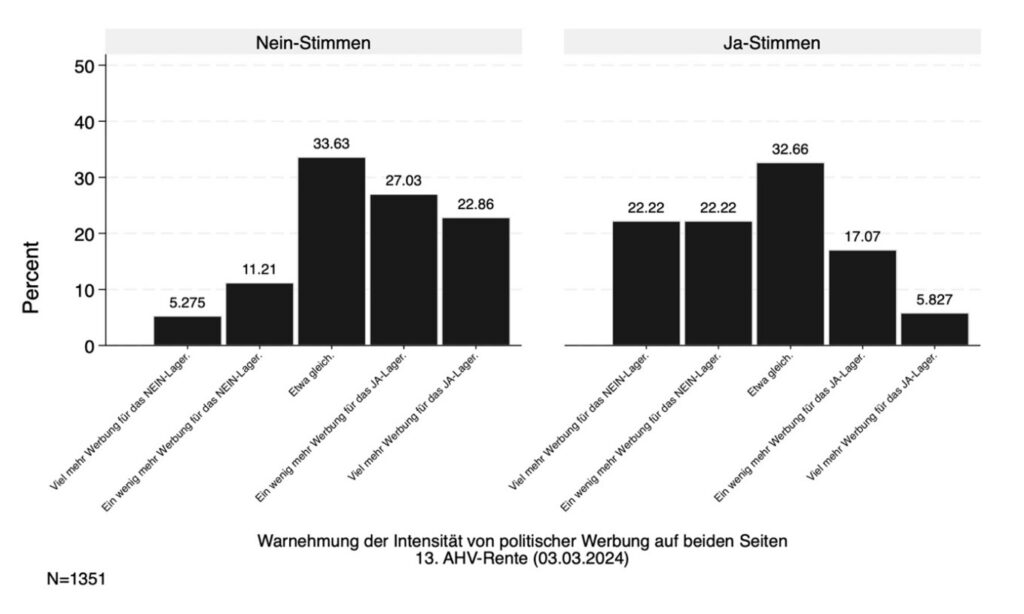
However, if we differentiate between the perceptions of the yes and no camps, a more interesting effect emerges: the overestimation of the opposing side. When citizens are asked whether they believe one side was promoted more strongly than the other, the objective metrics do not correspond as well with subjective perceptions. Those who accepted a proposal generally estimated that the ‘no’ camp had run a more intensive campaign – and vice versa. Their own voting decision thus influenced their perception of how effective the opposing side’s campaign was.

One possible explanation for this effect could be that, from a psychological perspective, the different wording of the content resulted in a different assessment (framing bias). Interestingly, a similar effect occurs regardless of whether a camp wins or loses a vote.

Victim or outsider?

If a person votes yes and the proposal is rejected, respondents attributed this to the perceived financial superiority of the opposing camp. Seeing oneself as a «victim» of the higher budget of the opposing side can be a way of reducing the «stress» of a referendum defeat.

Fig. 1: How is the intensity of political advertising assessed by those voting yes and no on referendum 13 on the 13th AHV pension?

If the proposal is accepted, an outsider effect tends to kick in: even then, supporters (wrongly) assume that the opposing camp had more money at its disposal than their own. Despite the (supposed) campaign superiority of the opposing side, their own vote ultimately prevailed. The satisfaction that this brings is also stress-reducing in terms of «coping».

The authors of the evaluation summarise: «Even though it seems obvious that the intensity of referendum campaigns is important for the outcome of direct democratic decisions, we know surprisingly little about the effect of political advertising on individuals. Our findings suggest that citizens have a good sense of the intensity of political campaigns in general, but that this sense is misleading when it comes to distinguishing between the advertising power of the respective yes and no camps.»

The project «Direct Democracy Switzerland in the 21st Century (DDS21)»

Since 2023, the research project Direct Democracy Switzerland in the 21st Century (DDS21), funded by the Swiss National Science Foundation (SNSF), has been investigating the reasons for Swiss citizens’ participation and voting decisions after each federal referendum. Led by the Centre for Democracy Studies Aarau (CDA), which is affiliated with the University of Zurich, DDS21 brings together members of Switzerland’s eight university political science institutes and the Liechtenstein Institute.

The data used in this article comes from surveys conducted after the votes on 3 March 2024 and 9 June 2024, in which more than 1,000 people were asked about their perceptions of the intensity of the voting campaigns for the five proposals: 13th AHV pension, pension initiative, premium relief initiative, electricity law, cost brake initiative, stop compulsory vaccination. Advertising expenditure and the number of advertisements per initiative were compared with the estimated intensity of the campaign.

Further resources

Blogbeitrag auf der Plattform DeFacto:
German, French, Italian
Project website: https://www.dds21.uzh.ch/de.html

Questions

Prof. Dr. Marc Bühlmann, Director Année Politique Suisse
marc.buehlmann@unibe.ch, 079 354 88 79

Prof. Dr. Isabelle Stadelmann-Steffen, Institut für Politikwissenschaft Bern
isabelle.stadelmann@unibe.ch, 031 684 83 55

Prof. Dr. Daniel Kübler, Center for Democracy Studies Aarau
daniel.kuebler@zda.uzh.ch, 078 815 67 60

About the CDA

The Centre for Democracy Studies Aarau is a scientific research centre supported by the University of Zurich, the University of Applied Sciences and Arts Northwestern Switzerland, the Canton of Aargau and the City of Aarau. It conducts basic research and addresses current issues relating to democracy – regionally, in Switzerland and worldwide. www.zdaarau.ch

About Année Politique Suisse

Since 1965, Année Politique Suisse (APS) has been providing a precise, factual and concise chronicle of developments in Swiss politics and society. We follow political issues from their inception to any referendums and their implementation, report on important social controversies, summarise practical studies and reports, track landmark court rulings, developments in the party landscape and much more. A central concern for us is to embed current events in their historical context, because current events are often merely highlights of lengthy, often repetitive processes that can be traced with APS and placed in a larger context.

APS also provides a wealth of data on Swiss politics (e.g. swissvotes.ch) and participates in various political science research projects focusing on Switzerland. www.anneepolitique.swiss

Thank you very much!

We would like to thank you sincerely for your interest and for attending the 2026 Aarau Democracy Days. Both the academic conference and the evening event were fully booked. We are already looking forward to the next edition in 2027.